
Boxelder Bug Control in Longmont, CO
- Pest Control Service in Longmont
- Rodent Control (Mice & Rats)
- Rodent Exclusion & Entry-Point Sealing
- Ant Control
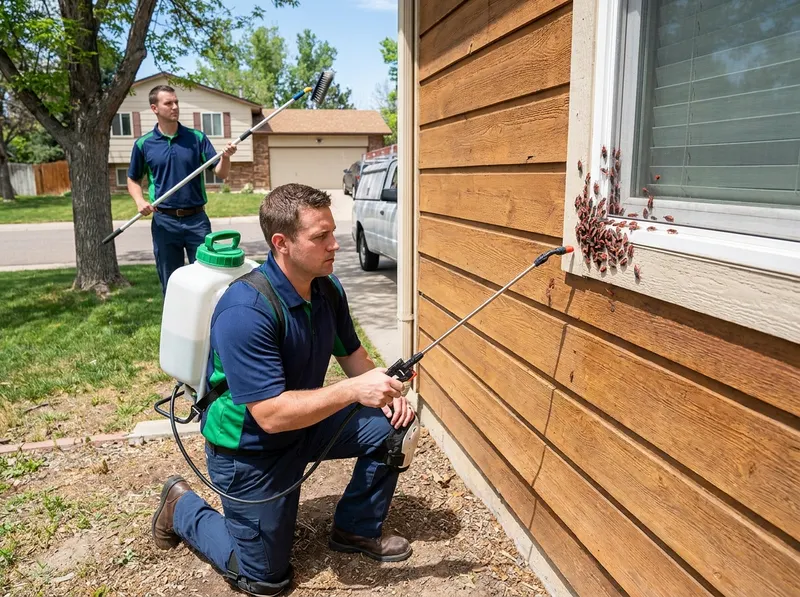
- Included: full exterior inspection with an Entry-Point Report, targeted treatment of south- and west-facing walls, eaves, window frames and foundation lines, plus a written note on which gaps need sealing.
- Timing: most Longmont boxelder calls are scheduled within a few business days; late August through October is the highest-value window, before the bugs settle into wall voids.
- Cost: boxelder bug service in Longmont starts at a $250 minimum for a standard single-family exterior, with larger or multi-story homes typically landing in the $300-$500 range.
- What we handle: adult boxelder bug clusters on siding and trim, entry-point identification, and coordination with any nearby seed-bearing boxelder or silver maple that is feeding the population.
- Booking: call or text (303) 531-5636 for a free on-site visit — we walk the exterior with you and confirm the exact price before any treatment starts.
<p>Boxelder bugs live on the seeds of female boxelder and silver maple trees, and Longmont has plenty of both — mature stands along the St. Vrain Greenway, the Left Hand Creek corridor, older alley lots in Old Town Longmont, and shade trees planted decades ago around Roosevelt Park. From those trees the bugs move to whatever surface holds heat longest in the afternoon. That means brick and stucco on south and west elevations, dark garage doors, and the sunny side of detached garages in Southmoor Park and Mill Village. <strong>If your boxelder bugs are always on the same wall, that wall is the treatment target — not the tree, and not the ones you vacuumed off the window.</strong></p><p>The decision most homeowners face is exterior treatment versus exclusion, and honestly the answer is usually a mix weighted by season. <strong>Treating before the bugs go in is far more effective than treating after.</strong> A well-timed exterior application in late summer or early fall knocks down the aggregations forming on siding and reduces how many make it into wall voids for winter. Once they're already inside — behind the drywall in a Fox Meadows bonus room, in the attic of a Rider's Ridge two-story — interior spraying accomplishes little, because they're not feeding and they're not concentrated. At that stage the honest plan is vacuum the strays, and seal in spring or summer so next fall is different.</p><p>Exclusion is the part most sprays skip. Boxelder bugs need only a narrow crack: unsealed siding-to-trim joints, gaps around hose bibs and dryer vents, worn weatherstripping on a sliding door, and the small separations that show up along foundation lines as Front Range clay soil swells and shrinks through wet springs and dry Augusts. Newer south-side subdivisions like Clover Basin, Somerset Meadows and Ute Creek tend to be tight but have long sunny elevations with lots of penetrations; older Old Town and Lake Park homes have fewer penetrations but looser windows and stone foundations. <strong>We document every gap we find and tell you which ones actually matter for boxelder bugs</strong>, so you're not sealing your whole house to solve one wall.</p><p>A realistic expectation, because we'd rather set it now: boxelder bug populations are driven by nearby host trees, so a treated home in a neighborhood with heavy seed trees may still see occasional bugs on warm winter and early-spring afternoons when overwintering adults wake up and crawl toward light. What good service delivers is a large reduction in the fall wall clusters and far fewer bugs finding their way inside. Homes on larger irrigated lots near Union Reservoir or out toward the Weld County edge sometimes need a second fall visit as the seeds drop and the bugs shift. <strong>We'll say so up front rather than after the invoice.</strong> No contract is required to have us out for the inspection, and we'll tell you the product we're using, where it goes, and how long to keep kids, pets and vegetable beds clear of treated surfaces.</p>
Call (303) 531-5636Boxelder Bug Control pricing in Longmont
| Free on-site inspection and Entry-Point Report | $0 |
| Standard single-family exterior boxelder treatment (Longmont city limits) | starts at $250 |
| Larger or two-story home, extended sunny elevations | $300-$500 |
| Two-visit fall boxelder program (peak aggregation + follow-up) | $400-$650 |
| Targeted exclusion / sealing of identified entry points | $250-$650+ depending on scope |
| Detached garage, shed or outbuilding add-on | From $250 |
Exact price confirmed free on-site before any work.
Boxelder Bug Control — questions, answered
When is the best time for boxelder bug treatment in Longmont?
Late August through October is the best window in Longmont, because boxelder bugs are then massing on warm exterior walls and have not yet moved into wall voids. A spring visit is the right choice if you already had bugs inside last winter — spring is when sealing work pays off for the following fall.
Do I need to cut down the boxelder tree in my Longmont yard?
No — removing a tree is rarely necessary for boxelder bug control in Longmont. Female seed-bearing boxelder and silver maple trees feed the population, but many host trees sit on neighboring lots, along the St. Vrain Greenway, or in city right-of-way, so we focus on the walls and entry points of your home instead.
Are boxelder bugs dangerous to my family or pets in Longmont homes?
Boxelder bugs are a nuisance pest, not a health threat — they don't bite people or pets, don't sting, and don't damage wood or wiring in Longmont homes. The real complaints are staining when they're crushed and the sheer numbers on sunny siding and windowsills.
Why do boxelder bugs keep coming back to the same wall of my Longmont house?
They return to the same wall because that surface holds afternoon heat the longest — typically the south or west side of a Longmont home in brick, stucco, or dark siding. Treatment is aimed at that specific elevation, along with the trim joints and vents on it, rather than the whole yard.
How much does boxelder bug control cost in Longmont, CO?
Boxelder bug service in Longmont starts at a $250 minimum for a standard single-family exterior, and larger or multi-story homes generally run $300-$500. These are ballparks based on typical local homes; the exact price is confirmed during a free on-site visit at (303) 531-5636 before any work begins.