
Ant Control in Longmont, CO
- Pest Control Service in Longmont
- Rodent Control (Mice & Rats)
- Rodent Exclusion & Entry-Point Sealing
- Wasp & Hornet Nest Removal
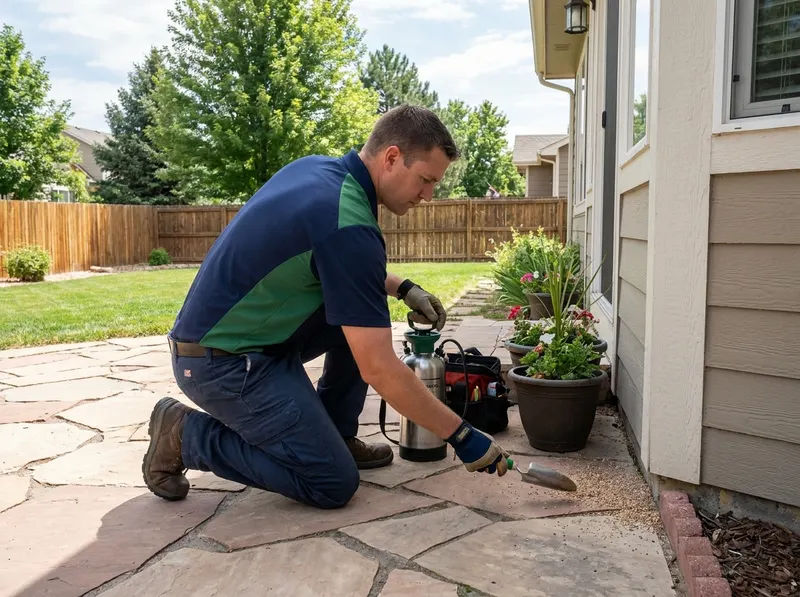
- What's included: species identification, interior trail treatment with targeted baits, an exterior perimeter application, inspection of foundation cracks and utility penetrations, and a written Entry-Point Report showing where the ants are getting in.
- How fast: most Longmont ant calls are scheduled within a few business days; visible trailing usually drops off within 3 to 10 days as bait moves through the colony.
- What it costs: ant service starts at a $250 minimum and typically runs $250 to $450 for a standard Longmont single-family home; carpenter ant work runs higher.
- What we treat: pavement ants, odorous house ants (the 'sugar ants' that smell like rotten coconut when crushed), field ants, and carpenter ants — indoors and along the exterior perimeter.
- How to book: call or text (303) 531-5636 for a free on-site inspection; the exact price is confirmed in person before any treatment begins.
Species drives the whole plan. Pavement ants are the most common complaint in Old Town Longmont, where mature brick walks, old concrete driveways, and expansion joints give them warm, protected nesting space right against the foundation — they push little volcano piles of soil out of the seams and follow the slab edge indoors. Odorous house ants dominate newer south-side subdivisions like Clover Basin, Somerset Meadows, and Rider's Ridge, where drip irrigation keeps soil damp under mulch beds and the colony sets up inches from the sill plate. Field ants build the domed mounds homeowners find in irrigated lawns around Ute Creek and Fox Meadows. Carpenter ants — the big black ones — tend to show up near mature cottonwoods and old silver maples along the St. Vrain Greenway and the McIntosh Lake side of town, and they are the one species where <strong>the ants may be nesting in damp wood rather than just visiting</strong>.
Here is the trade-off most homeowners never hear: a hardware-store contact spray kills what it touches and repels the rest. With odorous house ants, that repellency can cause the colony to split and relocate — a behavior called budding — so two weeks later you have trails in the pantry and in the bathroom instead of one line under the dishwasher. <strong>Slow-acting baits work in the opposite direction</strong>, moving through worker-to-worker feeding until they reach the queens. That is why our ant service leads with identification and bait placement, not a heavy interior spray, and why we ask you to stop wiping the trail before we arrive. The pheromone line is the map.
When does a simple treatment fit, and when does it not? If you have one trail, a known moisture source, and no structural wood damage, a single interior-and-perimeter visit resolves most Longmont ant problems. If you are finding coarse sawdust-like shavings, hearing faint rustling in a wall, or seeing winged ants indoors in spring, that points toward carpenter ants and a moisture problem — rotted trim, a leaking hose bib, a flat roof edge — and the correct answer is a wood-and-moisture inspection first. <strong>We will tell you when the real fix is a repair rather than a treatment.</strong> Front Range clay soil compounds all of it: it shrinks in dry spells and opens hairline gaps along foundation lines, and those gaps are the highway. Sealing them is a permanent gain that no spray replicates.
Safety is the second question we get after price, usually from homeowners with dogs and raised vegetable beds in Prospect New Town, Southmoor Park, and Mill Village. <strong>Show us the garden and the dog run before we start.</strong> Exterior perimeter products go on foundation bands, cracks, and structural voids — not on edibles — and interior work in kitchens is bait-station and crack-and-crevice placement out of pet reach. Your technician will tell you the product used, the re-entry interval, and exactly what the treatment will and will not fix. <strong>You get their name and their number, not a call center.</strong> We serve Longmont and the surrounding Boulder County area, with eastern-edge properties extending into Weld County.
Call (303) 531-5636Ant Control pricing in Longmont
| Standard ant service — interior trails + exterior perimeter, single-family home | $250 – $375 |
| Larger home or long foundation run (over ~2,500 sq ft or heavy landscaping) | $350 – $475 |
| Odorous house ant / multi-trail infestation with staged baiting and return visit | $375 – $550 |
| Carpenter ant treatment with wood + moisture inspection and void injection | $425 – $700 |
| Lawn and landscape field ant mound treatment (add-on to a home service) | $250 – $400 |
| Free on-site inspection and Entry-Point Report | No charge |
Exact price confirmed free on-site before any work.
Ant Control — questions, answered
How much does ant control cost in Longmont?
Ant control in Longmont starts at a $250 minimum, with most standard single-family homes landing between $250 and $450. Carpenter ant work runs higher because it includes a wood and moisture inspection plus void treatment. These are ballpark ranges — the exact price is confirmed during a free on-site visit, since foundation length, landscaping, and how many trails are active all change the scope.
Why do ants keep coming back in my Longmont kitchen after I spray?
Because the spray kills workers, not the colony. Foraging workers are a small fraction of an ant nest, and repellent sprays can push odorous house ants to split into satellite colonies elsewhere in the house. Longmont homeowners who report ants returning every two or three weeks almost always have an untreated nest outside the foundation. Baiting the trail and treating the perimeter is what breaks that cycle.
What kind of ants are in Longmont homes?
Longmont homes most commonly get pavement ants, odorous house ants, field ants, and carpenter ants. Pavement ants nest under slabs, driveways, and old brick walks — very common in Old Town Longmont. Odorous house ants favor moist mulch beds in newer south-side subdivisions. Carpenter ants show up near mature trees and damp wood. Identification matters because the bait and the treatment plan differ by species.
Is ant treatment safe around pets and vegetable gardens in Longmont?
Yes, when it is placed correctly. Exterior applications go on foundation bands, cracks, and structural voids rather than on edible plants, and interior work in Longmont kitchens uses baits and crack-and-crevice placement kept out of pet reach. Point out your vegetable beds, dog run, and any fish pond before treatment starts, and your technician will name the product used and the re-entry interval on site.
When is ant season in Longmont, and should I wait to call?
Ant activity in Longmont typically climbs from April through September, with the heaviest indoor trailing during hot, dry stretches when ants come inside hunting moisture. Do not wait — colonies grow through the season, and an early treatment reaches a smaller nest. If you already see a trail, leave it intact and call (303) 531-5636 so the technician can follow it back to the entry point.